The best light of the day, and how to be standing in the right place when it arrives — when golden hour falls through the year, where to shoot it in Cornwall, and the settings that hold the colour.
Jeremy Tucker · 9 min read
The sun going down behind Godrevy lighthouse — the last minutes of golden hour on the north Cornish coast.
Ask any landscape photographer when they work and the answer is nearly always the same: the hour after sunrise and the hour before sunset. It has a name — golden hour — and on the Cornish coast, with the Atlantic throwing light around and a headland in every direction, it is the difference between a snapshot and a photograph. The light is the easy part. The trick is being in the right place, facing the right way, when it happens.
What golden hour actually does
Golden hour is the stretch just after the sun rises or just before it sets, when the sun sits low and its light travels a long, shallow path through the atmosphere. That does three things all at once, and every one of them flatters the coast.
It turns warm. The low angle scatters the blue out of the light, leaving the golds, oranges and reds that give the hour its name. Granite, sand and sea all pick up the colour.
It turns soft. The light is raking sideways rather than beating straight down, so shadows lengthen and soften and the whole scene gains shape and depth. Midday light flattens the coast; golden hour sculpts it.
It turns directional. Because the sun is low and to one side, you can light a headland from the side, or shoot straight into it for silhouettes and glowing edges. You have options at golden hour that simply do not exist at noon.
The catch is that it does not last. In Cornwall in high summer, golden hour is a fast, bright twenty minutes; in the depths of winter, with the sun skimming low all afternoon, that beautiful light can stretch on for the best part of an hour. Either way, when it goes, it goes quickly.
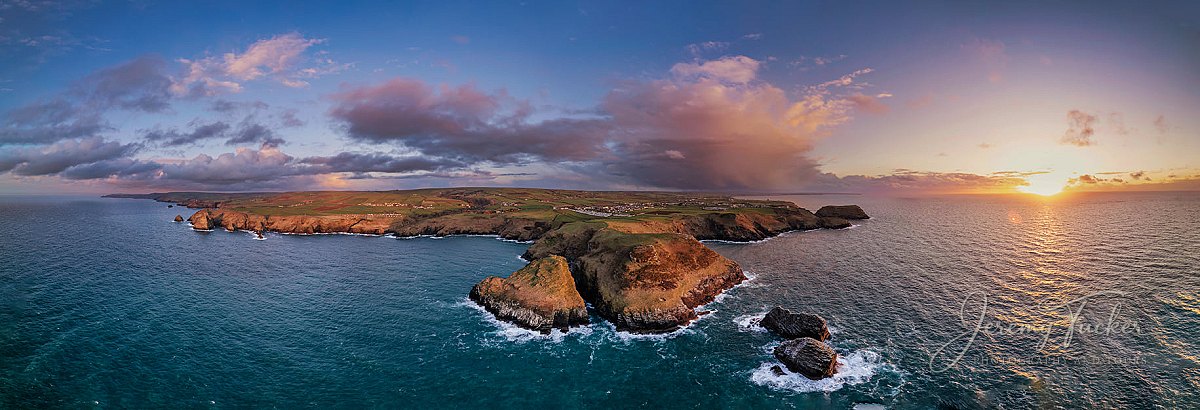
Pentire Point, Cornwall, in the last of the light — the low sun rakes across the headland from the side, giving it shape a midday sun would flatten.
When it happens — and how to know
Because the sun sets in a different place and at a different time every day, there is no fixed "golden hour o'clock". It shifts right through the year: a Cornish midsummer sunset is close to 9.30pm and swings round to the north-west, while a midwinter one is gone by half past four and sits low in the south-west. You have to look it up for the day you are going.
Two easy ways to do that:
The quick check. Any weather app, or the little conditions pill at the top of this site, will give you today's sunset time. Golden hour is roughly the hour before it. Aim to be set up and ready a good half-hour before sunset, not screeching into the car park as the sun touches the sea.
The proper plan. The app most of us use is PhotoPills (the same one in the moon and Milky Way guides). It tells you not just when the sun sets but where — the exact compass direction — so you can work out in advance whether it will drop behind the headland you have in mind, or off to one side.
Arrive early whatever you do. The best frames often come in the last few minutes before the sun goes, and the light can change completely in the space of a hundred seconds. You want to be composed and waiting, not still hunting for a spot.
Where to stand on the Cornish coast
For a golden-hour sunset you generally want a coastline that faces roughly west or south-west, so the sun goes down over the sea rather than behind the land at your back. Cornwall's far west is made for it — you are never far from an Atlantic-facing cliff. A few that reward the walk:
Godrevy and the north coast. The lighthouse on its island catches the setting sun beautifully, and St Ives Bay lights up behind it.
The Tin Coast — Botallack and Cape Cornwall. The old engine houses on the cliff edge, side-lit or silhouetted against a sinking sun, are the classic west-Cornwall golden hour.
Sennen and Land's End. Open Atlantic horizon, nothing between you and the sunset but water.
Kynance Cove and the Lizard. Serpentine stacks and turquoise water that turn molten in low light.
St Michael's Mount. From Marazion the sun sets to the side of the castle through much of the year — one of the most photographed sunsets in the county for good reason.
For a sunrise, turn the logic around and look for an east or south-east-facing spot — the harbours and estuaries of the south coast, or the eastern side of a bay. Fewer people, and the same warm light with the sea to yourself.
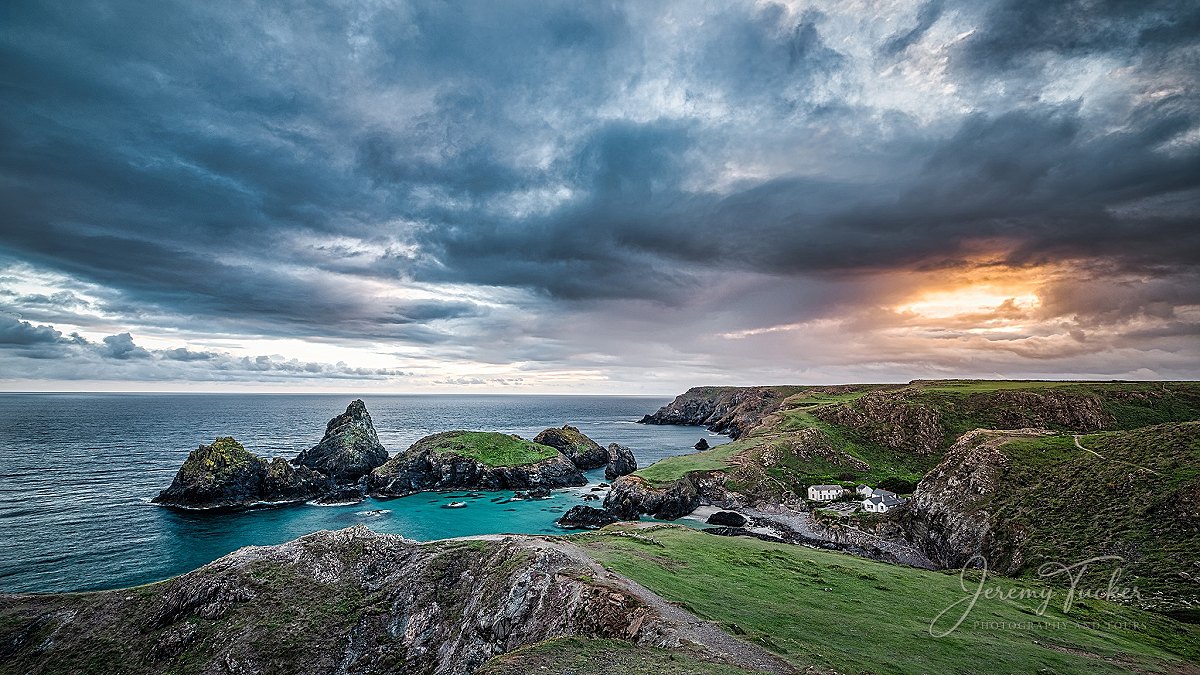
Kynance Cove on the Lizard — a shaft of low sun breaking under the cloud is often better than a clear sky. A little weather gives the light something to do.
How to shoot it
None of this needs exotic kit. It needs a few settings under control and a couple of cheap bits of glass.
Shoot raw, and keep the ISO low. There is plenty of light at golden hour, so ISO 100–400 and a clean file. Raw gives you room to bring out the colour later without it falling apart.
Take charge of the exposure. Left to itself the camera will try to make everything mid-grey and wash the colour out. Dial the exposure down a touch — expose for the bright sky and let the land go rich and dark. Watch the highlights so the sun itself does not blow out to a white hole.
A tripod. As the light drops your shutter speeds get longer, and a tripod is what lets you drop to ISO 100 and smooth the water without any shake.
Two filters earn their place. A polariser cuts glare off wet rock and water and deepens the sky; a graduated ND holds back a bright sky so it does not blow out while the foreground is still exposed. Neither is essential, but both make coast work easier.
Try a long exposure. A few seconds turns moving water to mist and swirl and simplifies a busy sea into something calm and graphic. This is where the tripod pays for itself.
Keep the warmth. If you shoot auto white balance the camera may try to "correct" the lovely orange away. Shoot raw and set it warm in editing, or nudge the white balance towards daylight/cloudy in camera so what you see is what you keep.
Making the picture: composition
Great light on a dull composition is still a dull composition. The coast gives you the ingredients — use them.
Give it a foreground. A rock, a pool holding the colour of the sky, a patch of clifftop thrift — something close in the frame gives the eye a way in and the picture depth. An empty beach and a nice sky is rarely enough.
Use the tide. Wet sand mirrors the sky, rock pools become pools of gold, and a receding wave leaves leading lines back towards the sun. Check the tide times before you go — the shot you have pictured may only exist at low water, or may be underwater when you arrive.
Shoot into the sun as well as with it. Turn your back to the sun and everything glows warm and side-lit; turn to face it and you get silhouettes, glowing edges and, if you stop the lens down to f/16, a crisp sunstar as the sun clips a horizon or a rock.
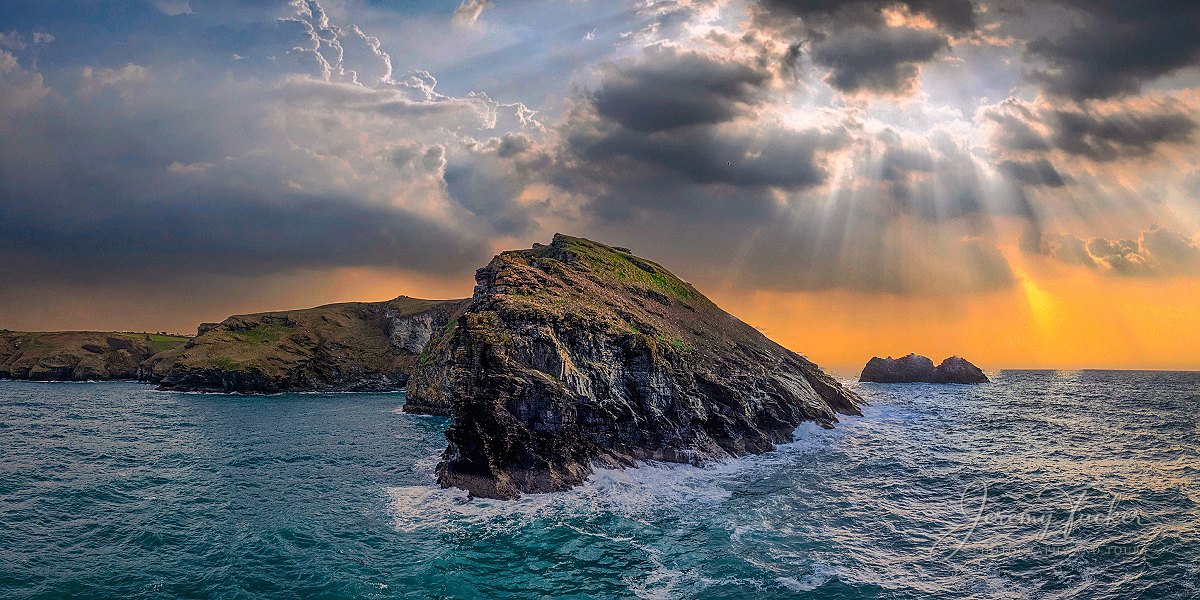
Breaking light over a Cornish sea stack. Shooting towards the sun through broken cloud gives you shafts and glow you will never get with it behind you.
Don't pack up at sunset — the blue hour
The single most common mistake is leaving when the sun goes down. The twenty to thirty minutes after sunset — the blue hour — is often the best part of the evening. The sky glows through pink and orange into deep blue, the light goes soft and even, and any lighthouse, harbour or town lights start to switch on and balance beautifully against the last colour in the sky.
It is the same trick as the moon behind the Mount relies on: the gap between the brightness of the sky and the brightness of the land closes right after sunset, so a single frame can hold both. Stay put, keep shooting, and let the blue hour come to you.
Staying safe on the coast
Golden hour ends in the dark. You will often be on rocks or a cliff path as the light fails, so plan the way back before you lose it. Check the tide so you are not cut off in a cove, keep well back from wet cliff edges and slippery seaweed, take a head torch, and tell someone where you have gone. The Atlantic is not to be turned your back on — never watch the sea through the viewfinder alone. No photograph is worth a soaking, or worse.
The honest bit
You cannot order golden hour. Cornwall will give you flat grey evenings where the sun never appears, and you will drive home with nothing — that is simply the deal on this coast. But a little cloud is a gift, not a curse: an empty blue sky makes for a boring sunset, while broken cloud catches fire and gives the light something to do. Learn to read the forecast, go often, and stay to the end, and the coast will hand you evenings you could not have invented.
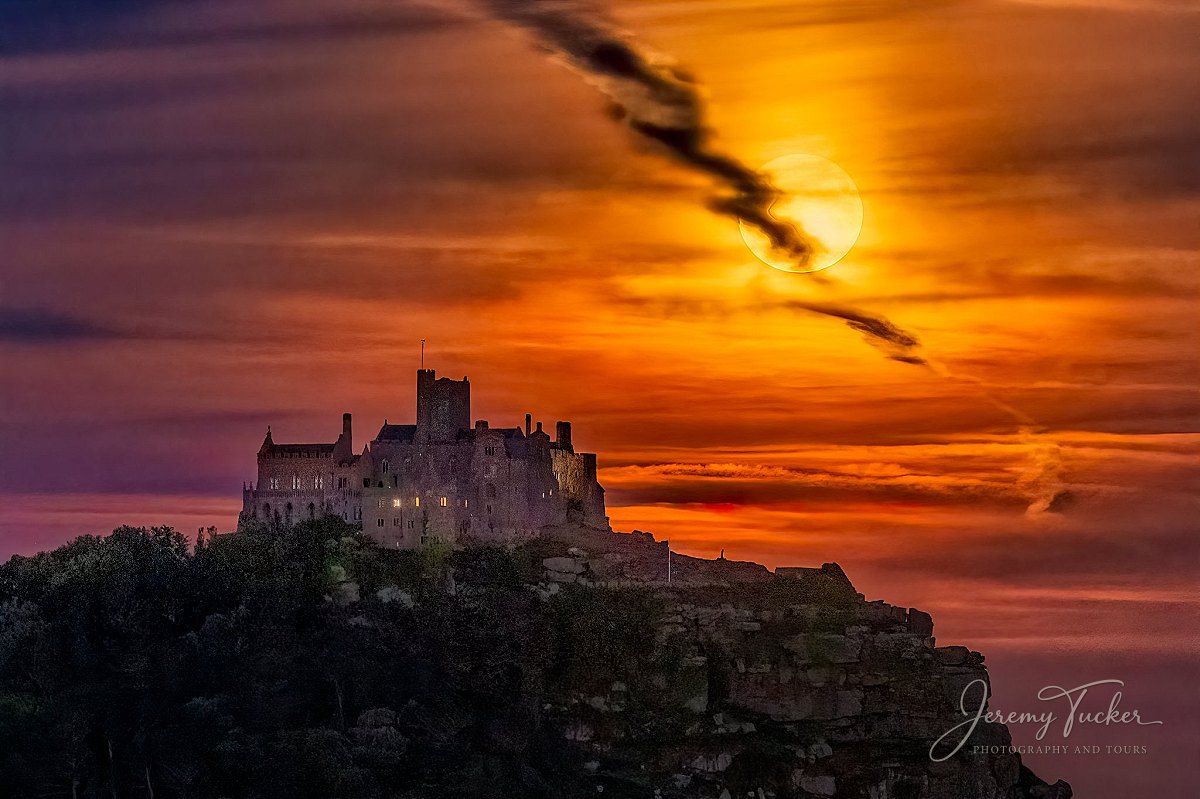
St Michael's Mount under a burning sky — the reward for turning up on the right evening, and staying to watch the whole thing go.
✓ The website watermark is never on your print. Every print is made from the original, full-resolution file — clean, unmarked, exactly as photographed.
Size
Finish
Price—Incl. worldwide shipping
Your Basket
Total£0
Worldwide shipping included · No watermark on prints