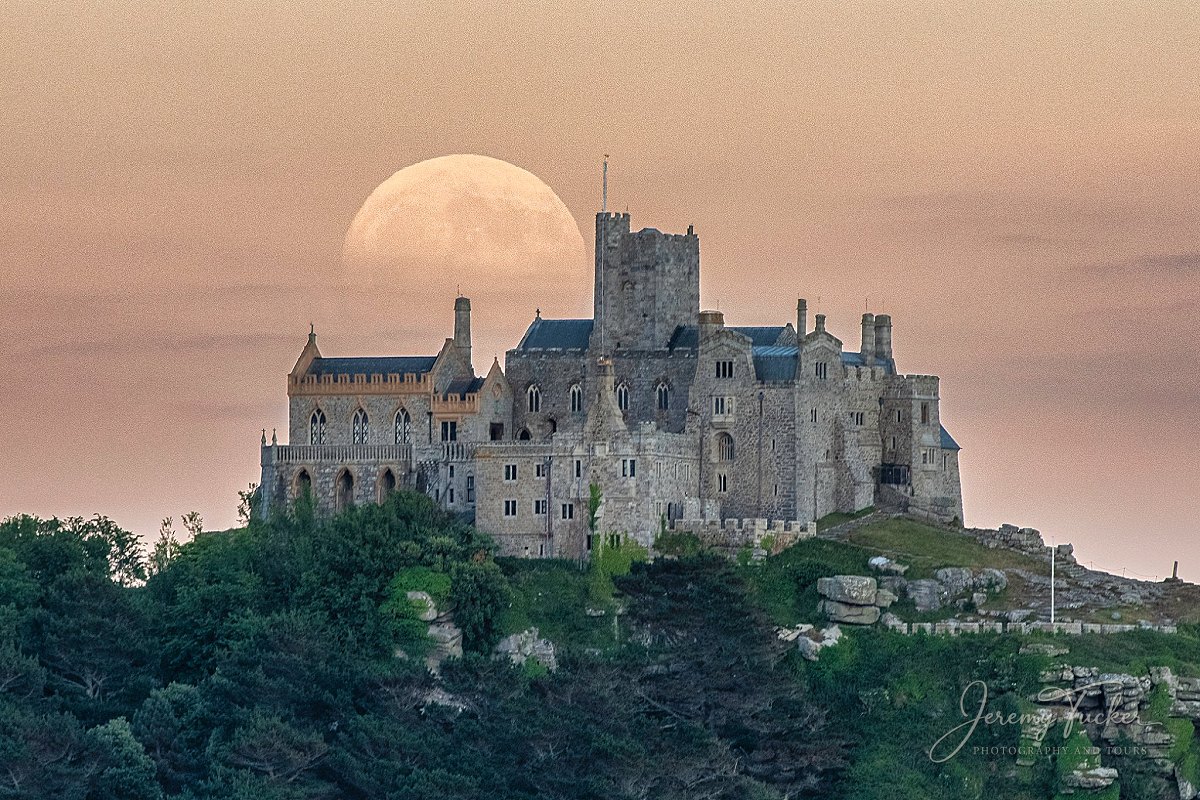
The full moon rising behind St Michael's Mount, shot from the shore of Mount's Bay.
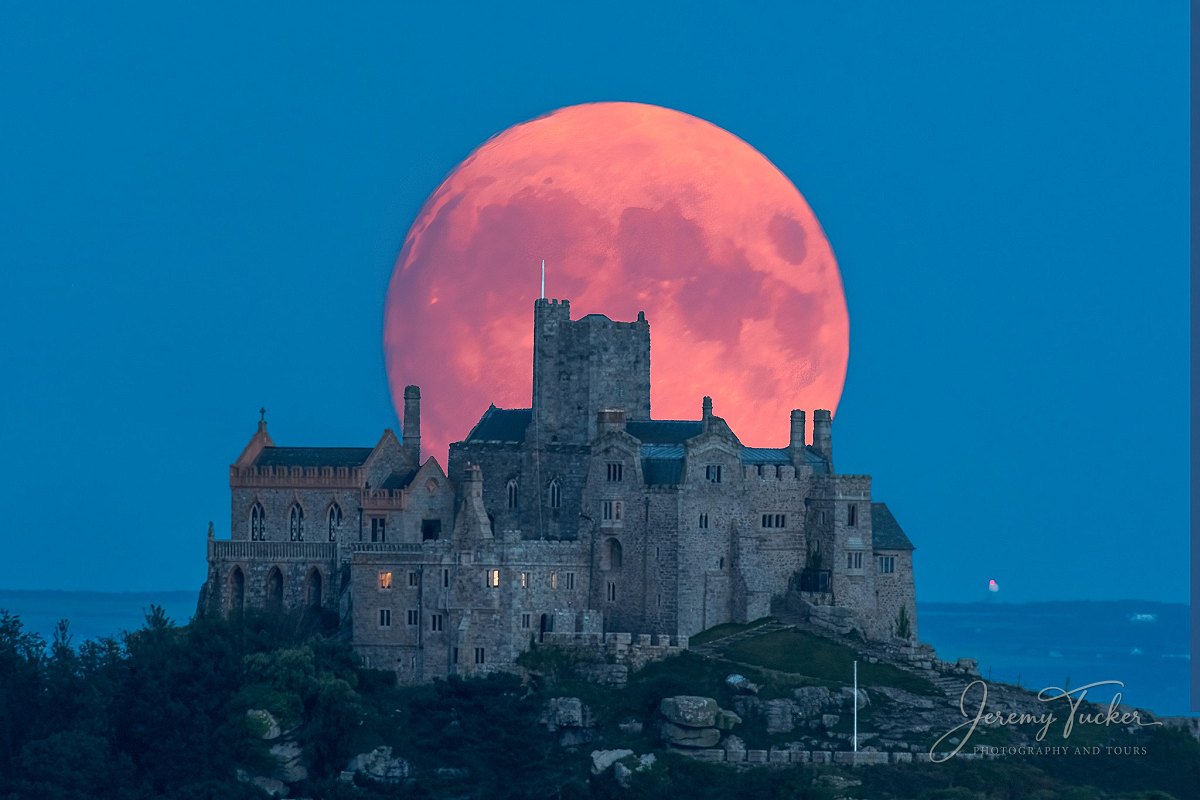
It is probably the most photographed idea in Cornwall: a huge orange full moon lifting out of the sea directly behind St Michael's Mount. Most people who try it come home disappointed — not because they got the date wrong, but because they got the evening wrong. Here is the difference, and the dates.
The short answer
You want the moon to clear the Mount within about half an hour after sunset. Not an hour later. Not the following night. That narrow window is the entire trick, and it is why a full moon in the calendar is not the same thing as a full moon worth photographing.
Why shortly after sunset, and not later
This is a dynamic range problem, and it catches everyone out.
The moon is not a light source. It is a rock in full sunlight — which means a correctly exposed full moon needs roughly the same exposure as a sunlit landscape here on earth. Something in the region of f/11 at 1/125th at ISO 100. It is, photographically speaking, daylight.
Now think about St Michael's Mount an hour after sunset. It is nearly dark. To get any detail in that castle you need an exposure hundreds of times longer than the moon needs. Your camera cannot do both in one frame, so you get one of two pictures, and both are the picture nobody wants:
Shortly after sunset, that gap closes. There is still light in the western sky falling on the castle, the sea and the cloud, while the moon is dimmed and reddened by the thick band of atmosphere it is climbing through near the horizon. For twenty or thirty minutes the two are close enough in brightness that a single exposure holds both — detail in the moon, detail in the Mount, and colour in the sky behind them. That is the shot.
There is a second reason. Low down, the atmosphere scatters the blue out of the moon's light exactly as it does with the setting sun, which is where the deep orange comes from. Get the moon high in a black sky and it turns a hard silver-white. All the warmth is in those first few degrees above the horizon.
So why isn't every full moon the same?
Because "full moon" is an instant, not an evening, and the moon rises roughly 50 minutes later each day. On the day of a full moon it rises at about sunset — but "about" is doing a lot of work in that sentence. Depending on the month, moonrise can land anywhere from half an hour before sunset to an hour after it.
Which means the best evening is often not the calendar full moon. It is whichever evening that month puts moonrise in the window. Sometimes that is the day before, sometimes the day after. You have to check each month rather than assume.
Get it wrong in the early direction and the moon comes up in broad daylight, pale and washed out against a bright sky. Get it wrong in the late direction and you are back to the white blob.
Where to stand — and why it moves through the year
Here is the part almost nobody mentions. There is no single spot for this photograph.
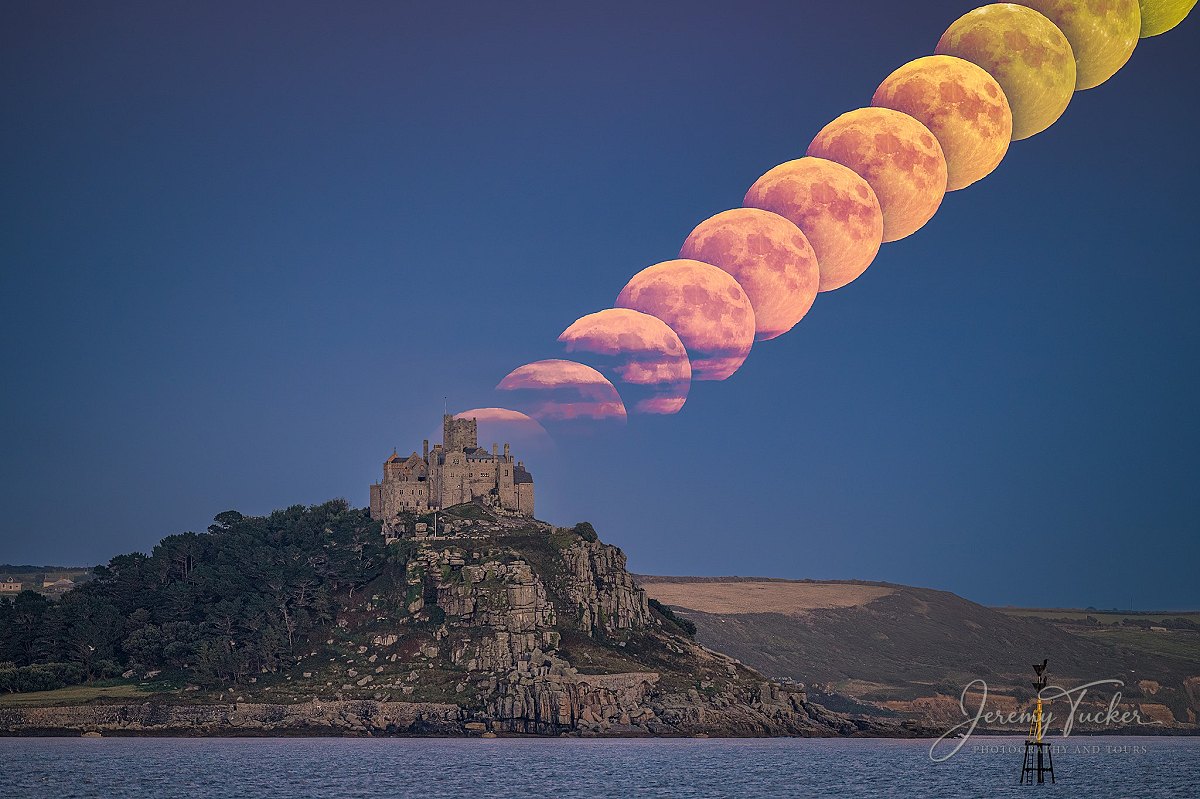
The full moon rises opposite the sun. So in high summer, when the sun sets in the north-west, the full moon comes up in the south-east — and the place that lines it up behind the Mount is the shore at Marazion, barely a kilometre away. In midwinter the sun sets in the south-west and the full moon rises in the north-east, so the alignment happens from right across Mount's Bay: Newlyn, or Mousehole, five or six kilometres out.
That is not a compromise. It is an upgrade. The further away you stand, the more a long lens compresses the moon and the Mount together, and the bigger the moon looks against the castle. The winter alignments, shot from Mousehole with a long lens, give you a far more dramatic photograph than the summer ones — you are just standing a long way further back.
Between those extremes the alignment walks steadily along the shore: Marazion, Long Rock, Eastern Green, Penzance, Newlyn, Mousehole. The table below tells you which one you want for each date.
The dates, to October 2027
These are computed from JPL ephemeris data for Mount's Bay, not taken off a calendar. Times are local (BST or GMT as appropriate). "Clears the Mount" is when the moon lifts clear of the castle, which is a little after true moonrise because the Mount itself is in the way.
| Evening | Moon | Sunset | Clears the Mount | After sunset | Stand at |
|---|---|---|---|---|---|
| Tue 28 July 2026 | 99% | 21:10 | 21:42 | +31 min | Marazion |
| Fri 28 August 2026 | 99% | 20:14 | 20:32 | +17 min | Eastern Green, Penzance |
| Sun 27 September 2026 | 98% | 19:09 | 19:16 | +7 min | Newlyn |
| Tue 27 October 2026 | 96% | 17:07 | 17:30 | +22 min | Mousehole |
| Wed 25 November 2026 | 98% | 16:26 | 16:54 | +27 min | Mousehole |
| Thu 24 December 2026 | 99% | 16:23 | 16:54 | +31 min | Mousehole |
| Fri 22 January 2027 | 100% | 16:58 | 17:16 | +17 min | Mousehole |
| Tue 20 April 2027 | 100% | 20:23 | 20:48 | +24 min | Long Rock |
| Wed 19 May 2027 | 100% | 21:07 | 21:26 | +19 min | Marazion west beach |
| Thu 17 June 2027 | 99% | 21:34 | 21:38 | +4 min | Marazion west beach |
| Sat 17 July 2027 | 99% | 21:24 | 21:48 | +23 min | Marazion west beach |
| Tue 17 August 2027 | 100% | 20:37 | 20:52 | +15 min | Long Rock |
| Fri 17 September 2027 | 97% | 19:31 | 19:48 | +16 min | Newlyn |
| Sat 16 October 2027 | 98% | 18:29 | 18:32 | +3 min | Newlyn |
You will notice February and March 2027 are missing. That is not an oversight — in those two months the full moon simply does not clear the Mount inside the useful window from anywhere on this shore. Some months do not work, and it is better to know that than to drive out and find out.
The evening either side of a listed date is often worth a look too: the window is a night or two wide rather than a single date. And these are the alignment dates — Cornwall still has to give you a clear eastern horizon on the night, which is a separate gamble entirely.
Planning your own alignment: PhotoPills
Everything above is worked out for St Michael's Mount. If you want to pin down the exact spot to stand, check an evening I haven't listed, or do the whole thing for a different subject altogether, the app the rest of us use is PhotoPills. It's on iPhone and Android, you buy it once rather than subscribe, and it pays for itself the first time it stops you driving to the wrong beach.
Two of its tools do the heavy lifting for this shot:
There's a knack to it, and PhotoPills publish good step-by-step tutorials for the "moon behind a landmark" shot in particular, so I won't reprint them here. One thing worth saying, though: the app gives you the geometry — where and when — but it won't tell you whether the light will be any good. That is the sunset-timing part further up this page, and it is the bit people forget the app isn't doing for them. Line up the alignment in PhotoPills, then sanity-check it against the "shortly after sunset" rule, and you've got both halves of the picture.
What you need
The honest bit
Even with the maths right, cloud on the eastern horizon will end the evening, and that horizon is the one you cannot see from where you are standing. A little cloud is a gift — the moon glowing through it is often the best frame of the night. A solid bank is simply the end of it. That is the deal with this photograph, and it is why the ones that work are worth the trouble.